Pedir ayuda mientras horneas
Pedidos y preguntas en plena receta, con la respuesta que vas a escuchar.
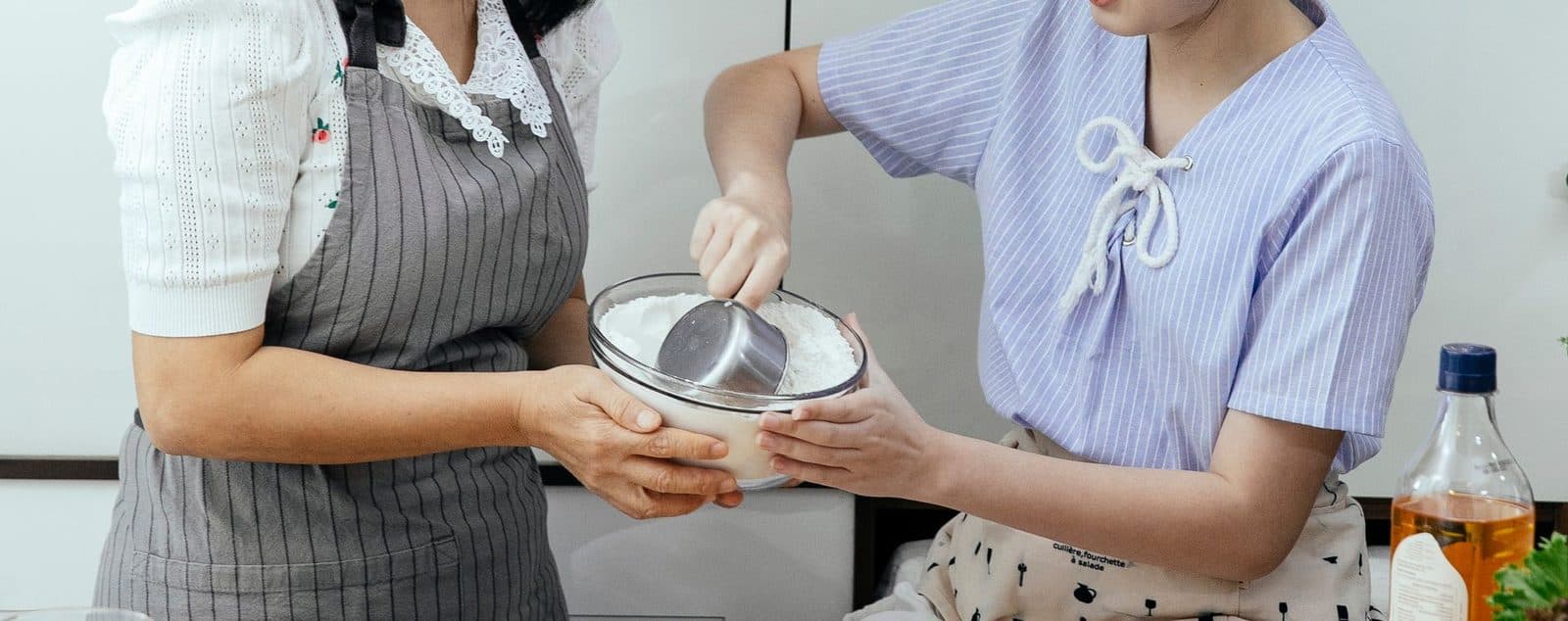
Dos personas, una cocina, una tanda de bollos: cada frase es una forma de pedir ayuda, en el orden del horneado. Buscar cosas, medir, las dudas de la masa, el horno, la autopsia cuando no creció y compartir el resultado. En inglés la cortesía se hace con can y could más el verbo sin to, no con una forma especial como el condicional español. Además, en EE. UU. se mide en tazas, cucharadas y grados Fahrenheit.
- 1
Can you read the recipe out loud?
¿Puedes leer la receta en voz alta?
Consejo: Respuesta: 'From the top?'. Can + verbo sin to, sin 'de'.
- 2
How much does the recipe say?
¿Cuánto dice la receta?
Consejo: Respuesta: 'Three cups.'. Con incontables (azúcar, harina) se usa much.
- 3
How many grams was it?
¿Cuántos gramos eran?
Consejo: Respuesta: 'Five hundred.'. Con cosas contables: many.
- 4
Could you get the flour down?
¿Podrías bajar la harina?
Consejo: Respuesta: 'Which shelf?'. Could suena más suave que can.
- 5
Top shelf, behind the sugar.
El estante de arriba, detrás del azúcar.
Consejo: Respuesta: 'Found it.'. En inglés no hace falta verbo ni artículo en una indicación rápida.
- 6
Is it sifted or not?
¿Está tamizada o no?
Consejo: Respuesta: 'It doesn't say.'. Sifted termina en sonido /ɪd/: no digas 'sifteed'.
- 7
Then it doesn't matter.
Entonces no importa.
Consejo: Respuesta: 'Good.'. 'Matter' = importar; el sujeto it nunca se omite.
- 8
Where's the rolling pin?
¿Dónde está el rodillo?
Consejo: Respuesta: 'In the drawer below.'. Where's = where is; la contracción es normal al hablar.
- 9
Could you weigh this for me?
¿Podrías pesar esto por mí?
Consejo: Respuesta: 'Which bowl should I use?'. Weigh se pronuncia como 'wei', la gh no suena.
- 10
Could you clear a space?
¿Podrías hacer un poco de espacio?
Consejo: Respuesta: 'I'll move this out of the way.'. Un verbo de limpiar/despejar, no 'hacer espacio'.
- 11
Could you wipe down the table?
¿Podrías limpiar la mesa?
Consejo: Respuesta: 'Should we roll it out there?'. Wipe = pasar un trapo; el verbo compuesto se puede separar.
- 12
Yes, lots of flour on it.
Sí, con mucha harina encima.
Consejo: Respuesta: 'It's going to get messy.'. Flour (harina) y flower (flor) suenan casi igual.
- 13
That's the whole point.
Ahí está todo el punto.
Consejo: Respuesta: 'True.'. Whole = entero; se escribe con w y se dice 'jol'.
- 14
Could you melt the butter?
¿Podrías derretir la mantequilla?
Consejo: Respuesta: 'In a saucepan or the microwave?'. Butter lleva una t suave, casi una d rápida.
- 15
Saucepan, on low heat.
Una cacerola, a fuego bajo.
Consejo: Respuesta: 'Got it.'. Heat = calor; 'a fuego bajo' es 'on low'.
- 16
Don't let it brown.
Que no se dore.
Consejo: Respuesta: 'I'm keeping an eye on it.'. Let + objeto + verbo sin to.
- 17
Could you crumble the yeast?
¿Podrías desmenuzar la levadura?
Consejo: Respuesta: 'Into the milk?'. Yeast suena 'iist', no 'yest'.
- 18
Into the bowl, yes.
Dentro del tazón, sí.
Consejo: Respuesta: 'Done.'. Into indica movimiento hacia adentro; in solo ubicación.
- 19
Is the dough supposed to be this sticky?
¿Se supone que la masa quede así de pegajosa?
Consejo: Respuesta: 'Just a little more flour.'. Dough rima con 'so'; no con 'rough'.
- 20
Can you help me knead?
¿Me ayudas a amasar?
Consejo: Respuesta: 'Let me wash my hands.'. La k de knead es muda: suena igual que 'need'.
- 21
Can you hold the bowl?
¿Puedes sostener el tazón?
Consejo: Respuesta: 'I've got it.'. Hold = sostener, no 'holdear'.
- 22
Is the dough ready, do you think?
¿Ya está lista la masa, tú qué crees?
Consejo: Respuesta: 'It's pulling away from the sides.'. Do you think va al final como remate.
- 23
That's the sign.
Esa es la señal.
Consejo: Respuesta: 'Good to know.'. Sign: la g no suena (/saɪn/).
- 24
Could you preheat the oven?
¿Podrías precalentar el horno?
Consejo: Respuesta: 'What temperature?'. Oven suena 'ávn'; la o es como una a corta.
- 25
Can you set a timer?
¿Puedes poner un temporizador?
Consejo: Respuesta: 'How many minutes?'. Set a timer, no 'put'.
- 26
Could you set the timer for eight?
¿Podrías poner el temporizador en ocho?
Consejo: Respuesta: 'Eight minutes, got it.'. 'For' + tiempo, no 'en'.
- 27
Yell when it goes off.
Grita cuando suene.
Consejo: Respuesta: 'Absolutely.'. Go off = sonar (una alarma); no es 'ir apagado'.
- 28
Could you brush them with egg?
¿Podrías pincelarlos con huevo?
Consejo: Respuesta: 'Where's the egg?'. Brush = pincel o cepillo; 'with' = con.
- 29
And then the coarse sugar.
Y luego el azúcar granulado grueso.
Consejo: Respuesta: 'Plenty?'. Coarse (áspero, grueso) suena como 'cors'.
- 30
Always a lot.
Siempre bastante.
Consejo: Respuesta: 'That's what I like to hear.'. Always va antes del verbo, pero aquí va al inicio de la frase corta.
- 31
Does it look done to you?
¿Te parece que ya está lista?
Consejo: Respuesta: 'Two more minutes.'. Look + adjetivo = parecer; done = lista, cocida.
- 32
Could you take them out?
¿Podrías sacarlos?
Consejo: Respuesta: 'Where are the oven mitts?'. Take out: el pronombre va en medio.
- 33
Would you taste this?
¿Podrías probar esto?
Consejo: Respuesta: 'A little more cardamom.'. Taste = probar un sabor; taste y test no son lo mismo.
- 34
Do we have more yeast?
¿Nos queda más levadura?
Consejo: Respuesta: 'Check the fridge.'. Do we have, no 'have we'.
- 35
Can you run to the store?
¿Puedes correr a la tienda?
Consejo: Respuesta: 'What do you need?'. En EE. UU. 'store', no 'shop', para una tienda normal.
- 36
Do you know why it didn't rise?
¿Sabes por qué no creció?
Consejo: Respuesta: 'The water was probably too hot.'. Después de why, orden de afirmación.
- 37
Should I start over?
¿Empiezo de nuevo?
Consejo: Respuesta: 'Just try one more time.'. Start over = empezar de cero.
- 38
Can you wash the dishes as we go?
¿Puedes lavar los platos sobre la marcha?
Consejo: Respuesta: 'I'll do it.'. Wash up y wash the dishes se usan igual.
- 39
Would you like one?
¿Quieres uno?
Consejo: Respuesta: 'Yes, please!'. Would you like es más amable que do you want.
- 40
Can you pass them around?
¿Puedes pasárselos a todos?
Consejo: Respuesta: 'Here you go, everyone.'. Pass around = hacer circular.
- 41
Take some home with you.
Llévate unos a casa.
Consejo: Respuesta: 'Only if you're sure.'. Take = llevar (de aquí hacia allá); bring = traer.
- 42
Of course, there's plenty.
Claro, hay de sobra.
Consejo: Respuesta: 'Thank you so much.'. There's = there is; plenty no lleva 'of' aquí.
- 43
Thanks, that helped a lot.
Gracias, me ayudó mucho.
Consejo: Respuesta: 'It was fun.'. Helped se pronuncia 'jelpt', con t final.
- 44
You saved the whole batch.
Salvaste toda la tanda.
Consejo: Respuesta: 'Don't exaggerate.'. Batch = tanda de horneado.
- 45
Thanks for the help.
Gracias por la ayuda.
Consejo: Respuesta: 'Anytime.'. Thanks for + sustantivo.
- 46
Want to bake again next week?
¿Quieres hornear otra vez la próxima semana?
Consejo: Respuesta: 'Absolutely, same day.'. Forma coloquial de Do you want to.