Mönsterdjupet: The mechanic says they're done
When the mechanic says your winter tyres are worn or too old: questioning the verdict, suspecting an upsell, asking for proof, and giving in gracefully.
You're at the workshop and the mechanic says the tyres won't do another winter. These are the things Swedes say to push back, check the facts and then accept it without losing face, in sections: taking in the news, questioning it, smelling an upsell, asking for evidence, second thoughts, accepting gracefully.
- 1
Säg som det är: är de körda?
Give it to me straight: are they done for?
Tip: 'Say it as it is' invites bluntness. The adjective is slang for finished or beyond saving, used of tyres, plans, even people.
- 2
Det var inte riktigt vad jag hade hoppats på.
That's not quite what I'd hoped to hear.
Tip: Mild disappointment, past tense even though the news is fresh: typical Swedish distancing. Much calmer than it sounds in English.
- 3
De har ju bara gått två säsonger.
They've only done two seasons, though.
Tip: Tyres 'walk' seasons in Swedish. The particle assumes the mechanic knows this too, so it's a gentle protest, not an accusation.
- 4
Klarar de en vinter till, eller är det att utmana ödet?
Will they get through one more winter, or is that tempting fate?
Tip: 'Challenge fate' is the idiom for tempting fate. You're asking for a risk judgement, which invites an honest answer.
- 5
Om du fick gissa, hur länge till hade de hållit?
If you had to guess, how much longer would they have lasted?
Tip: Past forms make it hypothetical and polite. A good way to get a straight number out of someone who is hedging.
- 6
Nu är du väl ändå lite väl försiktig?
Aren't you being just a touch overcautious?
Tip: Word play: the first one is the hoping-for-agreement particle, the second means 'too'. Teasing rather than rude, said with a smile.
- 7
De ser ju helt okej ut för ett otränat öga.
To the untrained eye they look perfectly fine.
Tip: Concedes you're no expert while still pushing back. The particle appeals to what anyone can see.
- 8
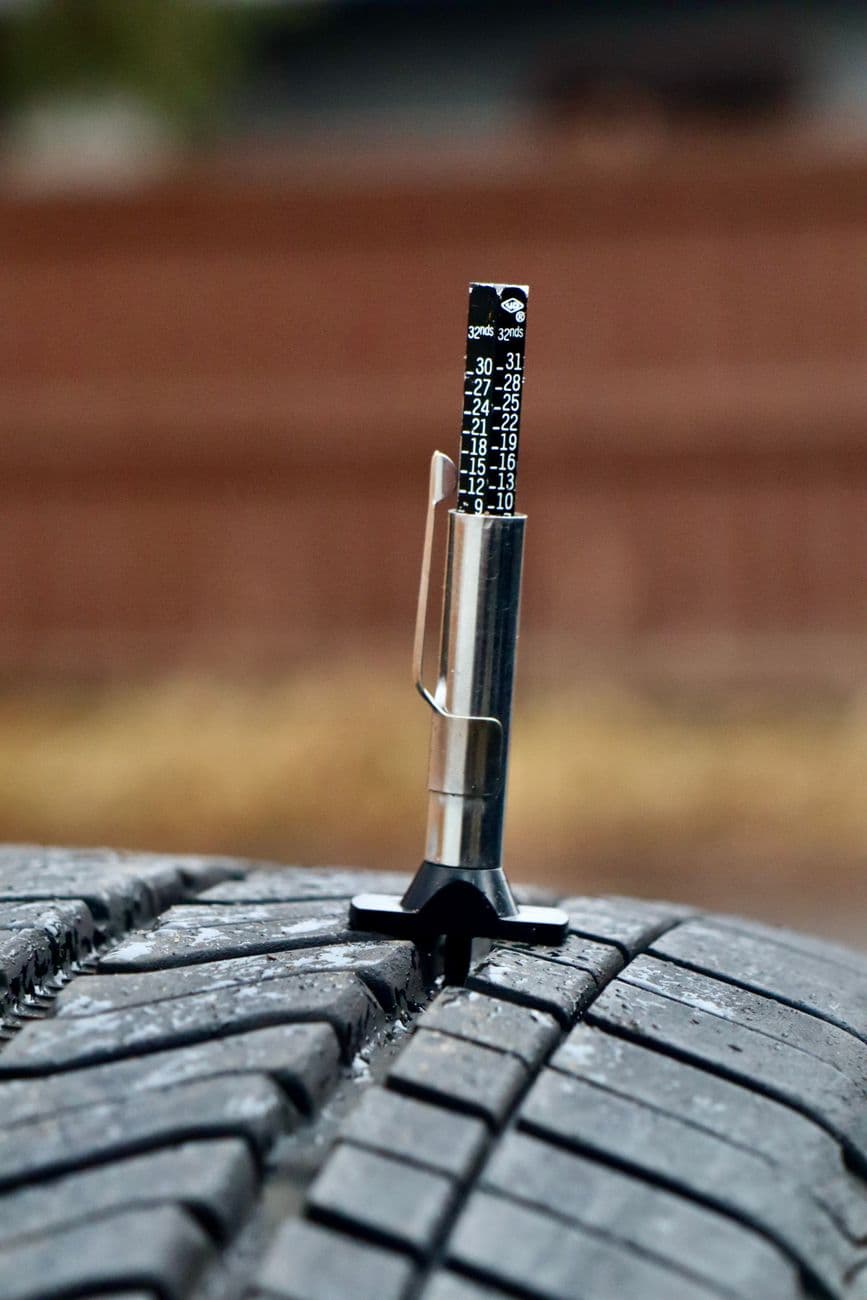
Lagkravet är väl tre millimeter, och de har ju mer än så?
The legal minimum is three millimetres, isn't it? And they've got more than that.
Tip: Correct for cars during the period when winter tyres are required, but legal is not the same as good on ice. Two particles: 'surely' and 'as we both know'.
- 9
Är det en rekommendation eller ett måste?
Is that a recommendation or a must?
Tip: The modal verb used as a neuter noun is everyday Swedish. A fair, neutral way to make the mechanic be precise.
- 10
Vad är det värsta som kan hända om jag chansar?
What's the worst that can happen if I chance it?
Tip: Half joking, half serious. The verb for taking a chance has no object here; it means gambling in general.
- 11
Ålder i sig säger väl inte allt?
Age alone doesn't tell you everything, does it?
Tip: 'In itself' is the neat Swedish for 'alone' or 'as such'. A reasonable challenge: condition matters as well as the date stamp.
- 12
Missförstå mig rätt, men ni säljer ju däck också.
Don't take this the wrong way, but you do sell tyres too.
Tip: A fixed, slightly paradoxical idiom: 'misunderstand me correctly'. It warns that something awkward is coming and softens it.
- 13
Du försöker väl inte pracka på mig nya däck nu?
You're not trying to palm new tyres off on me now, are you?
Tip: The particle verb means to push something on someone who doesn't want it. Joking tone keeps it from sounding like an accusation.
- 14
Hur mycket av det här är säkerhet och hur mycket är försäljning?
How much of this is safety and how much is sales?
Tip: Direct and fair. Most Swedish mechanics respect it, but say it calmly or it lands as a charge of dishonesty.
- 15
Jag vill bolla det med en kompis först.
I'd like to run it past a friend first.
Tip: The verb, from passing a ball about, means to talk an idea through with someone to get their view. Buys time without saying no, and sounds current, not evasive.
- 16
Får jag ta mig en titt själv?
Mind if I have a look for myself?
Tip: The extra reflexive pronoun after the verb is colloquial and makes the request relaxed rather than suspicious. Normal to ask with the car on the lift.
- 17
Mät gärna på flera ställen, de slits ju inte alltid jämnt.
Feel free to measure in a few places, they don't always wear evenly.
Tip: An imperative with the 'feel free' adverb is a polite instruction. Shows you know a bit about wear without lecturing.
- 18
Hur ser man egentligen hur gamla de är?
So how do you actually tell how old they are?
Tip: Two question words: the second part is an indirect question, so the subject comes before the verb. The adverb in the middle shows real curiosity.
- 19
Har ni mätt hårdheten, eller är det mer en känsla?
Have you measured the hardness, or is it more of a feeling?
Tip: Workshops can measure how hard the rubber has become. Asking shows you know old rubber grips worse, and pins them to facts.
- 20
Får jag se siffrorna svart på vitt?
Can I see the figures in black and white?
Tip: Same idiom as English, colours in the same order. Asking with the permission verb keeps it polite.
- 21
Kan du skriva det på arbetsordern, så jag har det?
Could you put that on the job sheet, so I've got it?
Tip: Gets the verdict in writing, which matters if you later want a second opinion or to complain. Calm, practical, not hostile.
- 22
Där fick du mig.
You've got me there.
Tip: 'There you got me', with the place word first for emphasis. Good-humoured admission that the other person has won the point.
- 23
Nu när du säger det, så har den känts lite osäker i kurvorna.
Now that you mention it, it has felt a bit unsteady on corners.
Tip: The extra 'so' after a fronted clause is pure speech; written Swedish drops it. 'It' is the car.
- 24
Om vi bara byter två, ska de nya sitta bak då?
If we only change two, should the new ones go on the back?
Tip: Swedish authorities advise the best pair at the rear, front- or rear-wheel drive alike. 'Then' at the end makes it a follow-up question.
- 25
Innerst inne anade jag att det var dags.
Deep down, I had a feeling it was time.
Tip: 'Innermost inside' is the idiom for deep down; fronting it sends the verb (sense, suspect) before the subject. Admitting it ends the debate gracefully.
- 26
Okej, jag ger mig.
Okay, I give in.
Tip: Reflexive 'give myself' means to surrender an argument. Short, friendly, no loss of face.
- 27
Det är väl bara att bita i det sura äpplet.
Well, I'll just have to bite the bullet.
Tip: Swedes bite the sour apple. 'It's only to' plus the particle: resigned, a little wry.
- 28
Hellre det än att sitta och chansa på isen i januari.
Better that than gambling on the ice in January.
Tip: 'Sit and' plus a verb paints an ongoing, slightly foolish activity. A good line to justify the spend to yourself.
- 29
Okej, du har övertygat mig. Vad landar det på?
Okay, you've convinced me. What does it come to?
Tip: The second question, built on the verb for a plane touching down, is current spoken Swedish for the final total. Moves straight from the decision to the bill.
- 30
Det är ju inte direkt gratis heller.
It's not exactly cheap either.
Tip: Classic understatement about a price that hurts: saying it isn't exactly free means expensive, with a wry sigh.
- 31
Tack för att du sa till, i stället för att bara köra på.
Thanks for telling me, rather than just carrying on.
Tip: The particle verb 'say to' means to flag something up; 'drive on' means carry on regardless. Good closing thanks to an honest mechanic.
- 32
Jag uppskattar att du var rak med mig.
I appreciate you being straight with me.
Tip: Being 'straight' is a strong compliment in Swedish working life. Ends the visit on good terms after you've questioned them.